

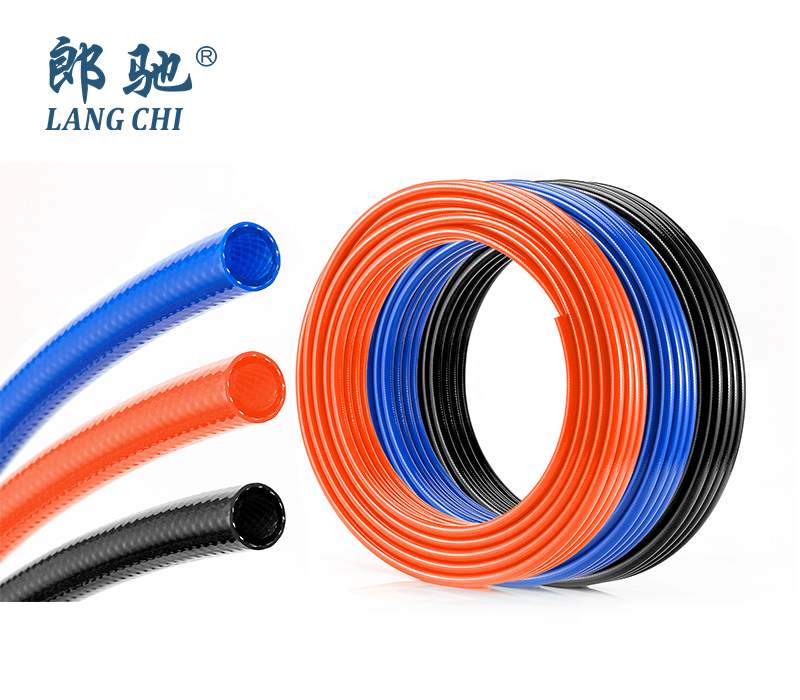
Selecting the right pneumatic tubing or reinforced flexible hose is critical for system longevity. Here is a direct, data-driven comparison between standard polyurethane tubing, precision polyether PU, and food-grade braided vinyl tubing.
The Core Data
| Feature | Standard PU Braided | Precision Polyether PU Braided | Food-Grade PVC Braided |
| Common Terms | pu tube, polyurethane pneumatic tubing, pneumatic pu tube, pu air tube | polyurethane tubing, high pressure air hose, pneumatic tubing, air tubing | pvc braided tubing, clear braided hose, braided vinyl tubing, PVC hose |
| Compatible Fluids | Air | Air / Water | Air / Water / Other Fluids |
| Max Pressure (20℃) | 1.4 – 1.6 Mpa | 1.4 – 1.6 Mpa | 1.0 – 1.5 Mpa |
| Max Pressure (60℃) | 0.6 – 0.8 Mpa | 0.6 – 0.8 Mpa | 0.3 – 0.4 Mpa |
| Min.Bend Radius 8mm (OD) | 35MM | 20MM | 10MM |
| Key Advantage | Cost-efficient air lines | Hydrolysis & chemical resistance | Phthalate-free, silicone-free |
1. Is PU safer than PVC?
It depends on the application environment. Both materials offer unique environmental advantages based on their formulation. Polyurethane is naturally flexible and chemically inert without volatile additives, making polyurethane pneumatic tubing preferred for standard eco-conscious lines.
However, Polyvinyl Chloride (PVC) is strong, lightweight, and inherently fire-resistant. While traditional industrial formulas require heavy plasticisers for flexibility, our premium pvc braided tubing uses specialized food-grade, phthalate-free, and silicone-free compounding. This ensures it is compliant for food processing, plumbing, and agriculture.
2. What are the differences between Ester-based and Ether-based PU?
Polyurethane tubing comes in two distinct types with specific environmental resistances:
Ester-based Polyurethane: Ester-based polyurethanes offer higher mechanical and adhesion strength. They provide fantastic tear resistance, making a standard ester-based pu air tube ideal for dry pneumatic lines.
Ether-based Polyurethane: While both types are highly resistant to abrasion, ether-based polyurethanes excel in low-temperature flexibility, hydrolysis resistance, and microbial resistance. If your application involves continuous water contact, cooling loops, or humid environments, choosing an ether-based polyurethane tubing prevents premature failure.
3. Acid, Base, and Chemical Resistance
PVC Performance: PVC possesses fantastic baseline resistance to acids and bases. This makes a PVC-based reinforced water hose highly effective in chemical processing or agriculture where corrosive fluids are handled.
PU Performance: Polyurethane offers high durability and is widely used in pneumatic control systems, robotics, and medical devices. While ester-based options handle oils and solvents well, they are less suited for concentrated acids and bases compared to PVC.
4. Flex Fatigue and Environmental Durability
Extreme Environments: Polyurethane maintains its flexibility even in extreme cold. Its ability to withstand harsh environments makes it a reliable choice for outdoor applications.
Mechanical Movement: For rapid-cycling robotics or dynamic pneumatic controls, a pneumatic pu tube offers the high abrasion resistance and elastic memory required to snap back without permanent deformation. Conversely, while a clear braided hose made of PVC offers an ultra-small bend radius (10mm) for tight static spaces, it is more prone to permanent kinking under continuous dynamic flexing.
Quick Selection Summary
Standard PU Braided (Ester-Based): Best for high-pressure, dry pneumatic automation or environments requiring heavy resistance to oils, solvents, and mechanical abrasion using an air hose or air compressor air hose.
Precision Polyether PU Braided (Ether-Based): Best for heavy-duty pneumatic tubing or air tubing that demands excellent low-temperature flexibility, microbial resistance, and constant exposure to water or high humidity.
Food-Grade PVC Braided: Best for a highly budget-friendly, fire-resistant reinforced flexible hose that requires excellent resistance to acids and bases, tight bend radii (10mm), or a clear braided hose for visual flow tracking.
Specialized Systems: Choose our reinforced silicone tubing for extreme thermal zones, or our wire reinforced hose for high-vacuum, anti-collapse performance.
Conclusion
Matching your equipment’s specific fluid, temperature, and spatial limits with the correct material prevents premature field failures and ensures maximum runtime. Contact our engineering team today to receive exact dimension data sheets for your next project.

